Wrangling data with dplyr
2025-08-09
Art by Allison Horst
The main verbs of dplyr

select()
filter()
mutate()
arrange()
summarize()
group_by()
The main verbs of dplyr
select() = Subset columns (variables)
filter()
mutate()
arrange()
summarize()
group_by()
select()
select()
# A tibble: 53,940 × 10
   carat cut     color clarity depth table price     x     y
   <dbl> <ord>   <ord> <ord>   <dbl> <dbl> <int> <dbl> <dbl>
 1  0.23 Ideal   E     SI2      61.5    55   326  3.95  3.98
 2  0.21 Premium E     SI1      59.8    61   326  3.89  3.84
 3  0.23 Good    E     VS1      56.9    65   327  4.05  4.07
 4  0.29 Premium I     VS2      62.4    58   334  4.2   4.23
 5  0.31 Good    J     SI2      63.3    58   335  4.34  4.35
 6  0.24 Very G… J     VVS2     62.8    57   336  3.94  3.96
 7  0.24 Very G… I     VVS1     62.3    57   336  3.95  3.98
 8  0.26 Very G… H     SI1      61.9    55   337  4.07  4.11
 9  0.22 Fair    E     VS2      65.1    61   337  3.87  3.78
10  0.23 Very G… H     VS1      59.4    61   338  4     4.05
# ℹ 53,930 more rows
# ℹ 1 more variable: z <dbl>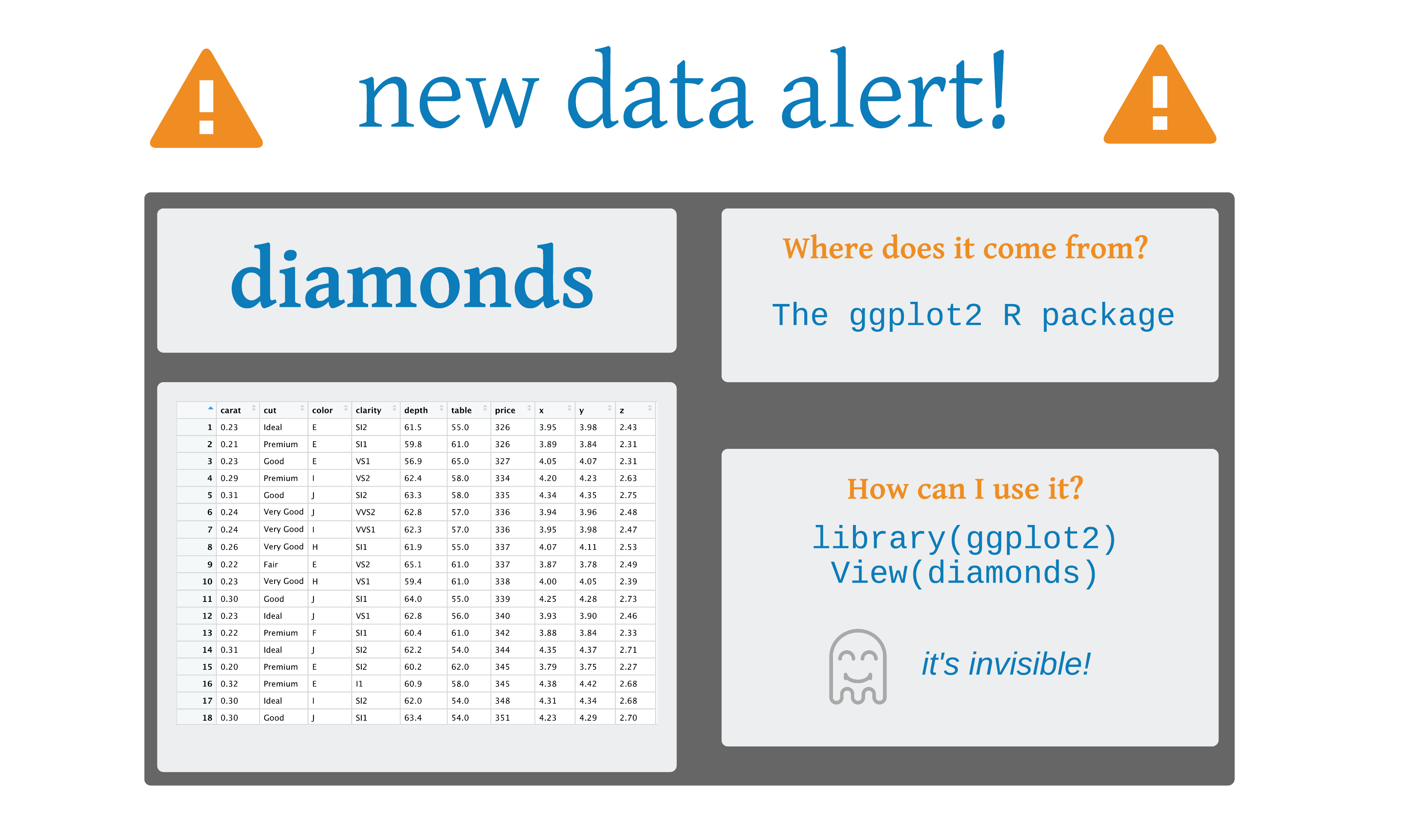
select()
select()
# A tibble: 53,940 × 4
   carat cut       color clarity
   <dbl> <ord>     <ord> <ord>
 1  0.23 Ideal     E     SI2
 2  0.21 Premium   E     SI1
 3  0.23 Good      E     VS1
 4  0.29 Premium   I     VS2
 5  0.31 Good      J     SI2
 6  0.24 Very Good J     VVS2
 7  0.24 Very Good I     VVS1
 8  0.26 Very Good H     SI1
 9  0.22 Fair      E     VS2
10  0.23 Very Good H     VS1
# ℹ 53,930 more rows
select()
gapminder
# A tibble: 1,704 × 6
   country     continent  year lifeExp      pop gdpPercap
   <fct>       <fct>     <int>   <dbl>    <int>     <dbl>
 1 Afghanistan Asia       1952    28.8  8425333      779.
 2 Afghanistan Asia       1957    30.3  9240934      821.
 3 Afghanistan Asia       1962    32.0 10267083      853.
 4 Afghanistan Asia       1967    34.0 11537966      836.
 5 Afghanistan Asia       1972    36.1 13079460      740.
 6 Afghanistan Asia       1977    38.4 14880372      786.
 7 Afghanistan Asia       1982    39.9 12881816      978.
 8 Afghanistan Asia       1987    40.8 13867957      852.
 9 Afghanistan Asia       1992    41.7 16317921      649.
10 Afghanistan Asia       1997    41.8 22227415      635.
# ℹ 1,694 more rows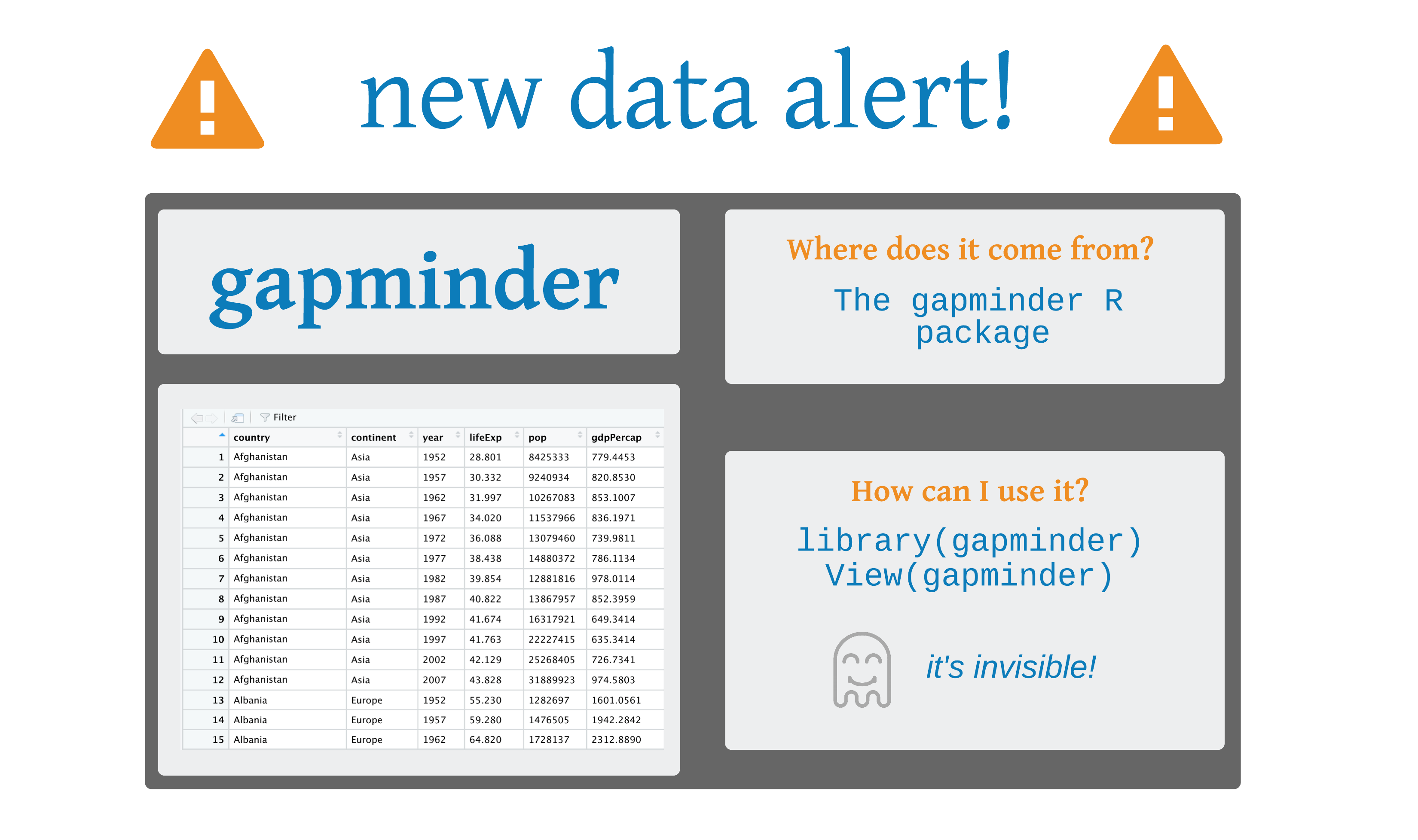
Your Turn 1
Alter the code to select just the pop column:
Your Turn 1
Make a prediction
Which of these is NOT a way to select the country and continent columns together?
Make a prediction
Which of these is NOT a way to select the country and continent columns together?
The main verbs of dplyr
select()
filter() = Subset rows by value
mutate()
arrange()
summarize()
group_by()
filter()
Predicates: TRUE or FALSE statements
Comparisons: >, >=, <, <=, != (not equal), and == (equal).
Operators: & is “and”, | is “or”, and ! is “not”
%in%
filter()
# A tibble: 4 × 10
  carat cut   color clarity depth table price     x     y
  <dbl> <ord> <ord> <ord>   <dbl> <dbl> <int> <dbl> <dbl>
1  3.22 Ideal I     I1       62.6    55 12545  9.49  9.42
2  3.5  Ideal H     I1       62.8    57 12587  9.65  9.59
3  3.01 Ideal J     SI2      61.7    58 16037  9.25  9.2
4  3.01 Ideal J     I1       65.4    60 16538  8.99  8.93
# ℹ 1 more variable: z <dbl>
Your turn 2
Show:
All of the rows where pop is greater than or equal to 100000
All of the rows for El Salvador
All of the rows that have a missing value for year (no need to edit this code)
Your turn 2
Show:
All of the rows where pop is greater than or equal to 100000
All of the rows for El Salvador
All of the rows that have a missing value for year (no need to edit this code)
filter()
# A tibble: 6 × 10
  carat cut      color clarity depth table price     x     y
  <dbl> <ord>    <ord> <ord>   <dbl> <dbl> <int> <dbl> <dbl>
1  3.22 Ideal    I     I1       62.6    55 12545  9.49  9.42
2  3.5  Ideal    H     I1       62.8    57 12587  9.65  9.59
3  3.04 Very Go… I     SI2      63.2    59 15354  9.14  9.07
4  4    Very Go… I     I1       63.3    58 15984 10.0   9.94
5  3.01 Ideal    J     SI2      61.7    58 16037  9.25  9.2
6  3.01 Ideal    J     I1       65.4    60 16538  8.99  8.93
# ℹ 1 more variable: z <dbl>
Your turn 3
Use Boolean operators to alter the code below to return only the rows that contain:
El Salvador
Countries that had populations over 100000 in 1960 or earlier
Your turn 3
Use Boolean operators to alter the code below to return only the rows that contain:
El Salvador
Countries that had populations over 100000 in 1960 or earlier
The main verbs of dplyr
select()
filter()
mutate() = Change or add a variable
arrange()
summarize()
group_by()
mutate()
mutate()
mutate()
# A tibble: 53,940 × 12
   carat cut     color clarity depth table price     x     y
   <dbl> <ord>   <ord> <ord>   <dbl> <dbl> <int> <dbl> <dbl>
 1  0.23 Ideal   E     SI2      61.5    55   326  3.95  3.98
 2  0.21 Premium E     SI1      59.8    61   326  3.89  3.84
 3  0.23 Good    E     VS1      56.9    65   327  4.05  4.07
 4  0.29 Premium I     VS2      62.4    58   334  4.2   4.23
 5  0.31 Good    J     SI2      63.3    58   335  4.34  4.35
 6  0.24 Very G… J     VVS2     62.8    57   336  3.94  3.96
 7  0.24 Very G… I     VVS1     62.3    57   336  3.95  3.98
 8  0.26 Very G… H     SI1      61.9    55   337  4.07  4.11
 9  0.22 Fair    E     VS2      65.1    61   337  3.87  3.78
10  0.23 Very G… H     VS1      59.4    61   338  4     4.05
# ℹ 53,930 more rows
# ℹ 3 more variables: z <dbl>, log_price <dbl>,
#   log_pricesq <dbl>
The main verbs of dplyr
select()
filter()
mutate()
arrange() = Sort the data set
summarize()
group_by()
arrange()
arrange()
# A tibble: 53,940 × 10
   carat cut     color clarity depth table price     x     y
   <dbl> <ord>   <ord> <ord>   <dbl> <dbl> <int> <dbl> <dbl>
 1  0.23 Ideal   E     SI2      61.5    55   326  3.95  3.98
 2  0.21 Premium E     SI1      59.8    61   326  3.89  3.84
 3  0.23 Good    E     VS1      56.9    65   327  4.05  4.07
 4  0.29 Premium I     VS2      62.4    58   334  4.2   4.23
 5  0.31 Good    J     SI2      63.3    58   335  4.34  4.35
 6  0.24 Very G… J     VVS2     62.8    57   336  3.94  3.96
 7  0.24 Very G… I     VVS1     62.3    57   336  3.95  3.98
 8  0.26 Very G… H     SI1      61.9    55   337  4.07  4.11
 9  0.22 Fair    E     VS2      65.1    61   337  3.87  3.78
10  0.23 Very G… H     VS1      59.4    61   338  4     4.05
# ℹ 53,930 more rows
# ℹ 1 more variable: z <dbl>
arrange()
# A tibble: 53,940 × 10
   carat cut   color clarity depth table price     x     y
   <dbl> <ord> <ord> <ord>   <dbl> <dbl> <int> <dbl> <dbl>
 1  0.22 Fair  E     VS2      65.1    61   337  3.87  3.78
 2  0.25 Fair  E     VS1      55.2    64   361  4.21  4.23
 3  0.23 Fair  G     VVS2     61.4    66   369  3.87  3.91
 4  0.27 Fair  E     VS1      66.4    58   371  3.99  4.02
 5  0.3  Fair  J     VS2      64.8    58   416  4.24  4.16
 6  0.3  Fair  F     SI1      63.1    58   496  4.3   4.22
 7  0.34 Fair  J     SI1      64.5    57   497  4.38  4.36
 8  0.37 Fair  F     SI1      65.3    56   527  4.53  4.47
 9  0.3  Fair  D     SI2      64.6    54   536  4.29  4.25
10  0.25 Fair  D     VS1      61.2    55   563  4.09  4.11
# ℹ 53,930 more rows
# ℹ 1 more variable: z <dbl>
desc()
# A tibble: 53,940 × 10
   carat cut   color clarity depth table price     x     y
   <dbl> <ord> <ord> <ord>   <dbl> <dbl> <int> <dbl> <dbl>
 1  2.01 Fair  G     SI1      70.6    64 18574  7.43  6.64
 2  2.02 Fair  H     VS2      64.5    57 18565  8     7.95
 3  4.5  Fair  J     I1       65.8    58 18531 10.2  10.2
 4  2    Fair  G     VS2      67.6    58 18515  7.65  7.61
 5  2.51 Fair  H     SI2      64.7    57 18308  8.44  8.5
 6  3.01 Fair  I     SI2      65.8    56 18242  8.99  8.94
 7  3.01 Fair  I     SI2      65.8    56 18242  8.99  8.94
 8  2.32 Fair  H     SI1      62      62 18026  8.47  8.31
 9  5.01 Fair  J     I1       65.5    59 18018 10.7  10.5
10  1.93 Fair  F     VS1      58.9    62 17995  8.17  7.97
# ℹ 53,930 more rows
# ℹ 1 more variable: z <dbl>
Your turn 4
Arrange gapminder by year. Add lifeExp as a second (tie breaking) variable to arrange on.
Which country had the lowest life expectancy in 1952?
Your turn 4
# A tibble: 1,704 × 6
   country       continent  year lifeExp     pop gdpPercap
   <fct>         <fct>     <int>   <dbl>   <int>     <dbl>
 1 Afghanistan   Asia       1952    28.8 8425333      779.
 2 Gambia        Africa     1952    30    284320      485.
 3 Angola        Africa     1952    30.0 4232095     3521.
 4 Sierra Leone  Africa     1952    30.3 2143249      880.
 5 Mozambique    Africa     1952    31.3 6446316      469.
 6 Burkina Faso  Africa     1952    32.0 4469979      543.
 7 Guinea-Bissau Africa     1952    32.5  580653      300.
 8 Yemen, Rep.   Asia       1952    32.5 4963829      782.
 9 Somalia       Africa     1952    33.0 2526994     1136.
10 Guinea        Africa     1952    33.6 2664249      510.
# ℹ 1,694 more rows
Your turn 5
Use desc() to find the country with the highest gdpPercap.
Your turn 5
# A tibble: 1,704 × 6
   country   continent  year lifeExp     pop gdpPercap
   <fct>     <fct>     <int>   <dbl>   <int>     <dbl>
 1 Kuwait    Asia       1957    58.0  212846   113523.
 2 Kuwait    Asia       1972    67.7  841934   109348.
 3 Kuwait    Asia       1952    55.6  160000   108382.
 4 Kuwait    Asia       1962    60.5  358266    95458.
 5 Kuwait    Asia       1967    64.6  575003    80895.
 6 Kuwait    Asia       1977    69.3 1140357    59265.
 7 Norway    Europe     2007    80.2 4627926    49357.
 8 Kuwait    Asia       2007    77.6 2505559    47307.
 9 Singapore Asia       2007    80.0 4553009    47143.
10 Norway    Europe     2002    79.0 4535591    44684.
# ℹ 1,694 more rows
Detour: The Pipe |>
Detour: The Pipe
Detour: The Pipe
Passes the result of one function to another function
Keyboard shortcuts
Insert <- with alt/opt + -
Insert |> with ctrl/cmd + shift + m
Keyboard shortcuts
Tools > Global Options > Code

The magrittr pipe
In the wild, you’ll see %>% a lot. This is the old pipe prior to when R had a built-in one. Either pipe is fine, but we’ll use the so-called native pipe |>
See R for Data Science for more info
Your turn 6
Use |> to write a sequence of functions that:
Filter only countries that are in the continent of Oceania.
Select the country, year and lifeExp columns
Arrange the results so that the highest life expectancy is at the top.
Your turn 6
gapminder |>
  filter(continent == "Oceania") |>
  select(country, year, lifeExp) |>
  arrange(desc(lifeExp))
# A tibble: 24 × 3
country year lifeExp
<fct> <int> <dbl>
1 Australia 2007 81.2
2 Australia 2002 80.4
3 New Zealand 2007 80.2
4 New Zealand 2002 79.1
5 Australia 1997 78.8
6 Australia 1992 77.6
7 New Zealand 1997 77.6
8 New Zealand 1992 76.3
9 Australia 1987 76.3
10 Australia 1982 74.7
# ℹ 14 more rowsChallenge!
1. Import the diabetes data from the importing data. A copy of the CSV file is available in this folder.
2. Add the variable bmi to the data set using height and weight using the formula: (weight / height^2) * 703
3. Select just id, glyhb, and the new variable you created.
4. Filter rows that have BMI > 35. How many rows and columns are in your new data set?
# A tibble: 61 × 3
      id glyhb   bmi
   <dbl> <dbl> <dbl>
 1  1001  4.44  37.4
 2  1002  4.64  48.4
 3  1022  5.78  35.8
 4  1029  4.97  40.8
 5  1253  4.67  36.0
 6  1254 12.7   42.5
 7  1280  5.10  38.3
 8  1501  4.41  40.0
 9  2753  5.57  35.3
10  2757  6.33  35.3
# ℹ 51 more rows
The main verbs of dplyr
select()
filter()
mutate()
arrange()
summarize() = Summarize the data
group_by() = Group the data
summarize()
summarize()
Your turn 7
Use summarise() to compute these statistics about the gapminder data set:
1. The first (min()) year in the data
2. The last (max()) year in the data
3. The total number of observations (n()) and the total number of unique countries in the data (n_distinct())
Your turn 7
group_by()
group_by()
# A tibble: 53,940 × 10
# Groups:   cut [5]
   carat cut     color clarity depth table price     x     y
   <dbl> <ord>   <ord> <ord>   <dbl> <dbl> <int> <dbl> <dbl>
 1  0.23 Ideal   E     SI2      61.5    55   326  3.95  3.98
 2  0.21 Premium E     SI1      59.8    61   326  3.89  3.84
 3  0.23 Good    E     VS1      56.9    65   327  4.05  4.07
 4  0.29 Premium I     VS2      62.4    58   334  4.2   4.23
 5  0.31 Good    J     SI2      63.3    58   335  4.34  4.35
 6  0.24 Very G… J     VVS2     62.8    57   336  3.94  3.96
 7  0.24 Very G… I     VVS1     62.3    57   336  3.95  3.98
 8  0.26 Very G… H     SI1      61.9    55   337  4.07  4.11
 9  0.22 Fair    E     VS2      65.1    61   337  3.87  3.78
10  0.23 Very G… H     VS1      59.4    61   338  4     4.05
# ℹ 53,930 more rows
# ℹ 1 more variable: z <dbl>
group_by()
# A tibble: 5 × 3
  cut           n mean_price
  <ord>     <int>      <dbl>
1 Fair       1610      4359.
2 Good       4906      3929.
3 Very Good 12082      3982.
4 Premium   13791      4584.
5 Ideal     21551      3458.
Your turn 8
Extract the rows where continent == "Europe". Then use group_by() to group by country. Finally, use summarize() to compute:
1. The total number of observations for each country in Europe
2. The lowest observed life expectancy for each country
Your turn 8
gapminder |>
  filter(continent == "Europe") |>
  group_by(country) |>
  summarize(n = n(), min_le = min(lifeExp))
# A tibble: 30 × 3
country n min_le
<fct> <int> <dbl>
1 Albania 12 55.2
2 Austria 12 66.8
3 Belgium 12 68
4 Bosnia and Herzegovina 12 53.8
5 Bulgaria 12 59.6
6 Croatia 12 61.2
7 Czech Republic 12 66.9
8 Denmark 12 70.8
9 Finland 12 66.6
10 France 12 67.4
# ℹ 20 more rowsYour turn 9
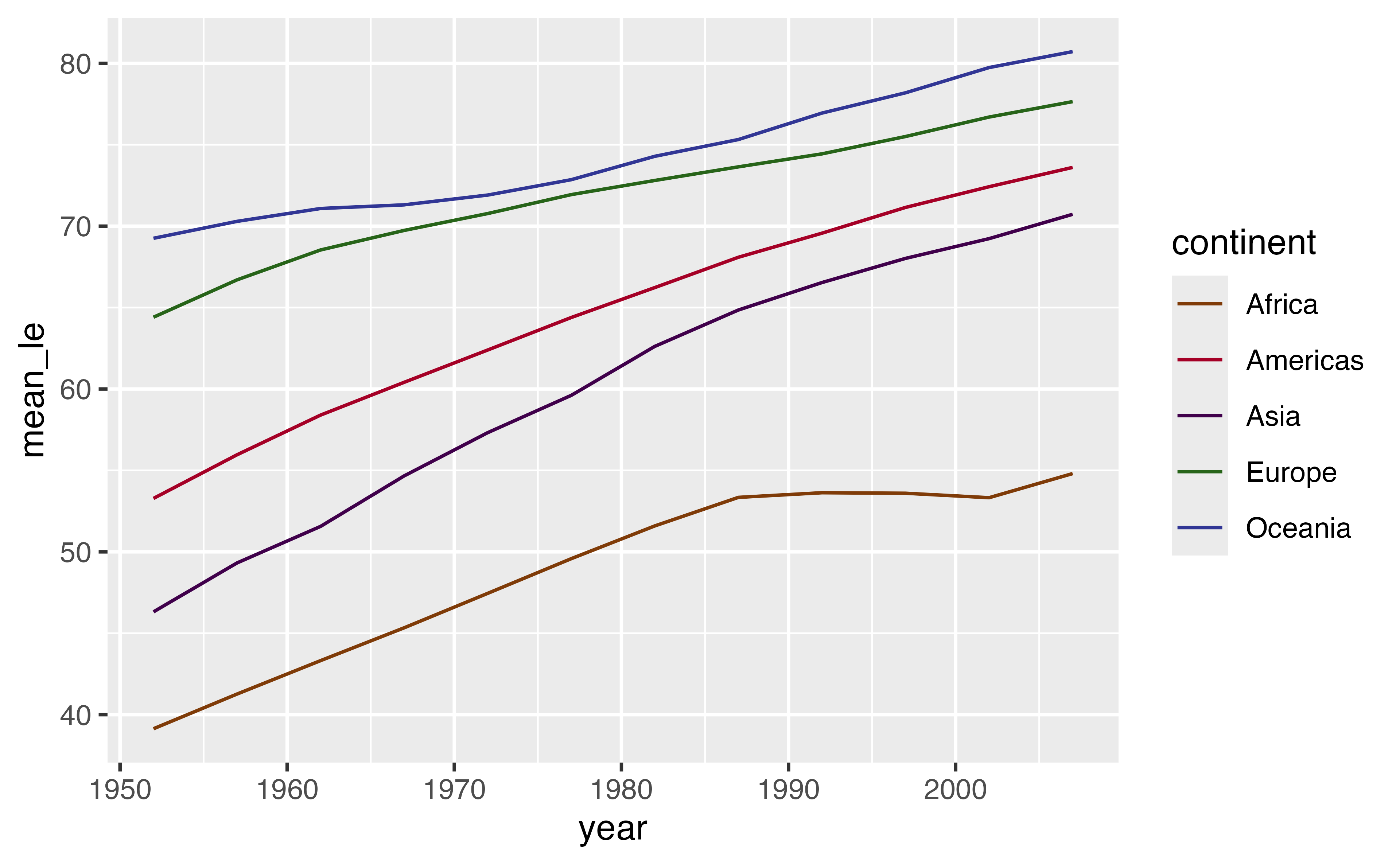
Use grouping to calculate the mean life expectancy for each continent and year. Call the mean life expectancy variable mean_le. Plot the life expectancy over time (no need to change the plot code).
Your turn 9
Use grouping to calculate the mean life expectancy for each continent and year. Call the mean life expectancy variable mean_le. Plot the life expectancy over time (no need to change the plot code).